Blog -11 : From the Source – Mold Determines Everything: TYOU PV Connector MC4 Quality Traceability
I. PV Connector mc4 : Small Component, Big Risk
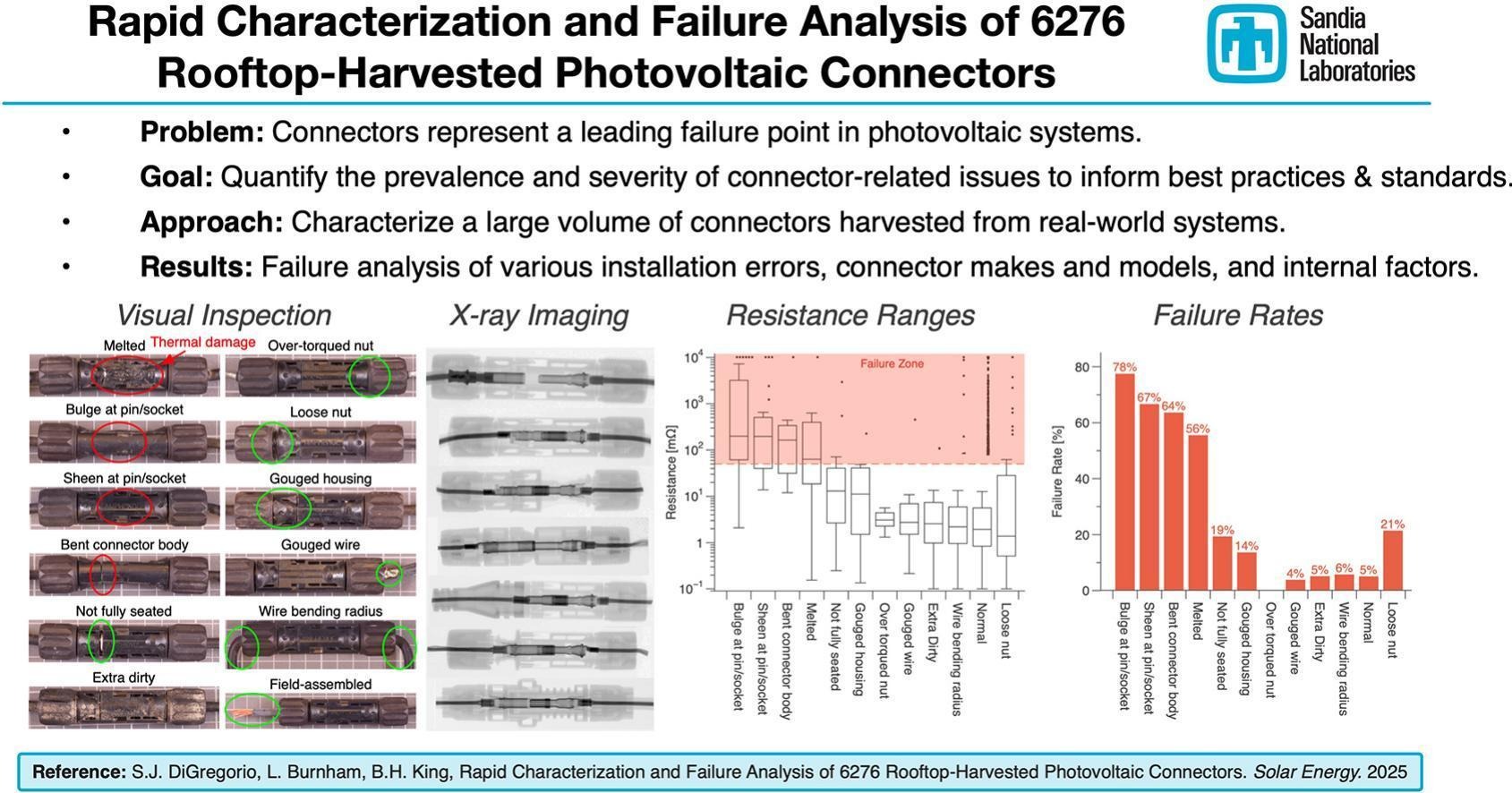
Data from multiple research institutions and actual PV power plants around the world confirm that PV connectors are a leading cause of PV system failures and a major contributor to PV fire accidents.
Reference:
Paper Title: Rapid characterization and failure analysis of 6276 rooftop-harvested photovoltaic connectors
Author/Institution: , ,
URL: //www.sciencedirect.com/science/article/pii/S0038092X25006796#recommended-articles
Screenshot: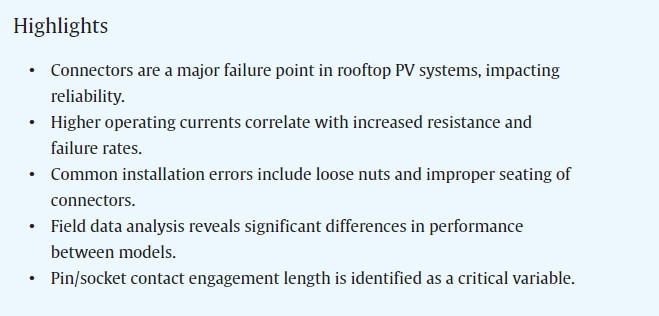
Paper Title: Rapid characterization and failure analysis of 6276 rooftop-harvested photovoltaic connectors
Author/Institution: , ,
URL: //www.sciencedirect.com/science/article/pii/S0038092X25006796#recommended-articles
Screenshot:
Connector failure is rarely sudden. It originates from minor increases in contact resistance, seal aging, or mechanical relaxation – gradually worsening over years of thermal cycling, vibration, and humidity – eventually leading to arcing, overheating, and even fire.
Therefore, PV connector quality directly determines the safety and profitability of a power plant.
How does TYOU PV connector ensure its quality from the very source – mold design, material selection, manufacturing, and dimensional control? Let us explain in detail.
II. The Mold: The “Gene” of PV Connector Quality
A connector is a typical precision injection-molded part. Wall thickness, snap-fit clearance, seal groove contour, internal contact positioning structure – all these critical features are directly replicated from the mold cavity.
The precision limit of a solar connector is determined at he mold design stage.
1. Precision Mold Design
① Dimensional & Geometric Tolerance Control
TYOU molds use micron-level (μm) tolerance control. Critical mating surfaces (e.g., plug bore inner diameter, snap-fit locking surfaces) are controlled to ±0.005mm – far exceeding the industry typical ±0.02mm.
② Injection Shrinkage Pre-compensation
Different plastics have different shrinkage characteristics. We apply precise compensation during mold design to prevent warpage, sink marks, and deformation:
| Material | Shrinkage Rate |
| PC / PE / PPO | 0.6% |
| PA (Nylon) | 0.8% |
③ Advanced Mold Flow Analysis
Using CAE mold flow simulation software, combined with 20 years of production experience, we predict and avoid potential defects early, establishing reliable injection molding process conditions. Key analyses include:
· Filling analysis: Can the plastic fully fill the cavity? Are gate locations optimal? Any short shots, trapped air, or weld lines affecting strength?
· Cooling analysis: Is cooling channel layout uniform? Cooling speed and temperature differences? Can cycle time be shortened?
· Packing & shrinkage analysis: Any short filling, sink marks, or voids? Is internal stress excessive?
· Warpage analysis: Bending, twisting, or dimensional deviation? Adjust gates/cooling/process to correct.
· Fiber orientation analysis (for glass-filled PA+GF): Predict fiber alignment effects on strength and deformation.
· Cooling analysis: Is cooling channel layout uniform? Cooling speed and temperature differences? Can cycle time be shortened?
· Packing & shrinkage analysis: Any short filling, sink marks, or voids? Is internal stress excessive?
· Warpage analysis: Bending, twisting, or dimensional deviation? Adjust gates/cooling/process to correct.
· Fiber orientation analysis (for glass-filled PA+GF): Predict fiber alignment effects on strength and deformation.
④ Optimized Structural Design
We systematically optimize gate location, ejection mechanism, and cooling system to ensure:
· Fully automated production (no manual part removal)
· Dimensionally stable connectors with consistent appearance
· Dimensionally stable connectors with consistent appearance
2. The “Golden Partner” for Top Precision & Long Life – Mold Steel
① High-Performance Mold Steel
Cavity and core are made of VIKING or SKD61 – high toughness, high wear resistance – ensuring long mold life under high-volume production while maintaining connector dimensional accuracy and shape.
② Lifecycle-Based Material Selection
Targeting a service life of over 1,000,000 cycles, we match high-hardness quenched steel:
· SKD61: Hardness reaches HRC 60, annual corrosion rate ≤0.03mm
· For critical wear areas, hardness can reach 48–65 HRC, with annual corrosion rate controlled ≤0.05mm
· For critical wear areas, hardness can reach 48–65 HRC, with annual corrosion rate controlled ≤0.05mm
3. Achieving Micron-Level Tolerances – Precision Machining & Assembly
① High-Precision Machining Equipment Cluster
TYOU’s mold manufacturing center is located in Yuyao, Zhejiang – China’s mold capital. We are equipped with industry-leading machinery:
· 5-axis CNC machining centers (Swiss/Japanese imports)
· Precision EDM (Electrical Discharge Machining) with C-axis capability
· High-precision wire EDM (slow-speed)
· Precision surface grinders (PG optical grinders)
· Precision EDM (Electrical Discharge Machining) with C-axis capability
· High-precision wire EDM (slow-speed)
· Precision surface grinders (PG optical grinders)
These machines achieve 0.002mm machining capability at equipment level, ensuring precision on all critical mold dimensions.
② Mold Surface Treatment & Coating Technology
To enhance wear resistance, corrosion resistance, and demolding performance, we use advanced coating technologies:
· PVD (Physical Vapor Deposition) coating
· TiN (Titanium Nitride) coating
· DLC (Diamond-Like Carbon) coating – currently the best wear-reducing coating, friction coefficient as low as 0.05–0.1, hardness up to 3000 HV
· TiN (Titanium Nitride) coating
· DLC (Diamond-Like Carbon) coating – currently the best wear-reducing coating, friction coefficient as low as 0.05–0.1, hardness up to 3000 HV
Seal grooves, mating surfaces, etc., are polished to a mirror finish (Ra ≤0.05μm), giving smooth, consistent injection-molded parts that release easily without scratches.
③ Strict Assembly & Mold Trial Optimization
TYOU’s injection molding technicians all have over 10 years of hands-on experience. They perform precision mold assembly. During mold trials, we optimize using the following key parameters to eliminate defects and ensure the injection machine and mold operate at their best:
| Process Parameter | Setting Range |
| Barrel temperature Front (nozzle) | 280–300°C Middle: 270–290°C Rear: 250–270°C |
| Mold temperature | 60–75°C (typical for SKD61) |
| Injection pressure | 70–95 bar |
| Injection speed | Medium 40%–60% (slow for appearance parts, fast for structural parts) |
| Holding pressure | 60%–75% of injection pressure |
| Holding time | 1.5–3.5 s |
| Cooling time | 8–15 s (typical small parts) |
| Screw speed | 60–90 r/min |
| Melt cushion | 1.1–1.3 × part weight |
| Clamping force | Based on mold flow pressure, typically 80–160 T |
Through multiple trial runs, we lock in the optimal process window, ensuring consistent product quality from every cycle.
III. From Mold to Finished Product – A Lasting Commitment
Mold precision directly determines solar connector insertion/withdrawal force consistency, sealing reliability, and contact positioning accuracy – which in turn affects the long-term stability of the entire PV string.
TYOU has built a complete source quality control chain – from mold design → material selection → precision machining → assembly & trial → scientific maintenance. Every micron we insist on is for your power plant over the next 25 years:
· Fewer failures
· More electricity generation
· Greater safety
· More electricity generation
· Greater safety
Next article preview: How does TYOU further ensure connector long-term reliability from the plastic raw material level? Stay tuned.
Blog - 12: From the Source – Plastic Raw Materials Determine Service Life: TYOU Solar PV Connector 25-Year Reliability Assurance
Blog -10: Breaking into the Quarter-Cell Era: The Next-Gen 1500V Split Solar Junction Box
Related blog