
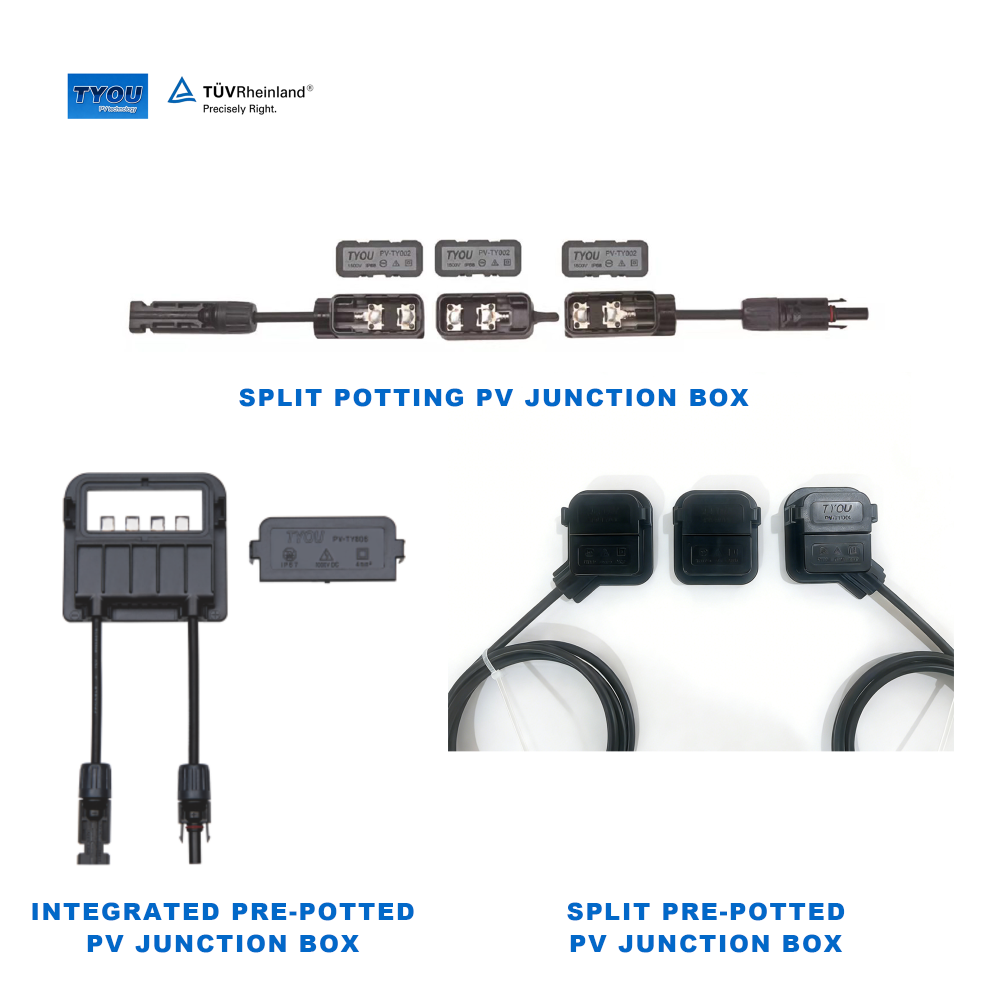
| Type | Description | Representative Model |
| Type A | Integrated Pre-potted | PV-TY806 |
| Type B | Three-part Pre-potted | PV-TY001NEW |
| Type C | Three-part Potted | PV-TY002 |
Dimension 1: Module Power & Current (Decisive Factor)
≤400W (current ≤16A): Recommended integrated type (PV-TY806) — lowest cost, fastest installation.
500W (current 20A ~ 30A ): Three-part type required - better heat dissipation, reduced hot-spot risk.
Dimension 2: Production Line Potting Process (Production Management Factor)
To eliminate potting steps / ensure consistency: Choose pre-potted (PV-TY001NEW).
Mature in-house potting equipment / seeking material flexibility: Choose potted type (PV-TY002).
Dimension 3: Application Environment (Reliability Factor)
Coastal / high humidity / high UV: IP68 rating + high-weather-resistance materials emphasized.
| Comparison Dimension | PV-TY806 | PV-TY001NEW | PV-TY002 |
| Structure Type | Integrated | Three Part | Three Part |
| Potting Method | Pre-potted | Pre-potted | On-site Potting |
| Rated Current | 15A, 16A | 20A,25A,30A | 20A,25A,30A |
| Applicable Power | ≤400W | ≥500W | ≥500W |
| Key Advantages | No potting needed, labor-saving | No potting needed, high heat dissipation | Mature process, flexible solution |
| Recommended Applications | Standard small modules / compact panels | Large wafer / bifacial / high-efficiency modules | Utility-scale power plants / high-volume production lines |
III. Why Choose a 3-Part (Split) Junction Box?
1. Superior Thermal Dissipation for High Currents
As solar modules have evolved towards larger wafers (182mm and 210mm) and higher power outputs (500W+), the operating current has significantly increased to 20A, 25A, or even 30A. In a traditional one-piece junction box, the three bypass diodes are housed in a single enclosure, leading to a concentration of heat. When a module is partially shaded, the diodes activate and generate heat in that confined space, which can drastically reduce the diode lifespan or lead to thermal runaway.
A 3-part split junction box solves this problem by separating the three diodes into three independent mini-enclosures. This physical separation eliminates thermal coupling, significantly reducing the junction temperature and enhancing the long-term reliability of the module under hot-spot conditions.
2. Optimized Compatibility with Modern Module Layouts
Modern high-efficiency panels often utilize half-cut cell technology or bifacial designs. These layouts frequently relocate the busbars and require flexible positioning of the connection points on the backsheet. Rigid, long one-piece junction boxes are often too large to fit these new layouts without blocking the light on bifacial modules or overlapping with the cells.
The compact nature of the 3-part design allows it to be mounted precisely at the end of each busbar. This provides module manufacturers with the ultimate flexibility to design smaller, smarter, and more efficient panel layouts without being constrained by the junction box dimensions.
3. Reduced Mechanical Stress on the Laminate
A solar panel undergoes extreme thermal cycling daily (from freezing at night to intense heat during the day). Plastics and glass expand and contract at different rates. A long, rigid one-piece box can create stress points along the laminate, potentially leading to micro-cracks in the cells.
Because a 3-part split junction box consists of three small, independent units, it exerts significantly less mechanical stress on the backsheet and glass. This reduces the risk of cell damage during lamination and thermal cycling tests (TC200/TC400).
4. Lower Production Scrap Rate
In the manufacturing process, if there is a defect in the soldering or the diode of a one-piece box, the entire unit must be scrapped and removed. However, with a 3-part split system, only the affected single segment needs to be replaced. This modularity results in a higher yield rate and lower overall production costs for module makers.
IV. Pre-potted vs. On-site Potting: Which Process is Right for You?
Choosing the right potting process is critical for both production efficiency and long-term field performance. We provide both options to match your specific manufacturing setup.
What is Pre-potted ?
Pre-potted junction boxes are filled and sealed with high-thermal-conductivity silicone gel at our facility using automated dispensing machines before shipment. When you receive the box, it is already a sealed, IP68-rated unit. You simply solder it to the panel and the module is finished—no additional gluing, filling, or curing is required on your line.
What is On-site Potting?
An un-potted or open junction box is shipped empty. Your production team must solder the box to the panel first, then inject the two-component silicone potting agent into the housing, and finally wait for the curing process to complete before packaging.
| Feature | Pre-potted (TY001NEW / TY806) | On-site Potting (TY002) |
|---|---|---|
| Production Efficiency | Highest. Solder and go. Eliminates the need for potting stations, curing ovens, and cleaning processes. | Slower. Requires additional labor, potting equipment, and several hours of curing time. |
| Quality Consistency | Excellent. Machine-filled under vacuum/de-aeration ensures zero bubbles and uniform thermal conductivity across every unit. | Variable. Highly dependent on operator skill and machine calibration. Risks include bubbles, incomplete filling, or uneven gel levels. |
| Reliability (IP Rating) | Guaranteed IP68 protection from the factory. The internal components are rigidly locked in place. | Can achieve IP68, but requires strict quality control (QC) to ensure there are no leakage paths. |
| Cost Structure | Slightly higher unit price (includes factory potting labor and gel). | Lower initial material cost; you control the gel sourcing and can optimize BOM costs for massive volume. |
| Supply Chain | Shorter line setup time; you rely on the supplier's expertise for the sealing process. | Greater flexibility to certify specific silicone brands (e.g., Dow, Wacker) in-house. |
Our Recommendation:
-
Select Pre-potted (TY001NEW) if your priority is zero-defect quality, reducing bottle-necks on your production line, or if you are ramping up a new facility without an established potting process.
-
Select On-site Potting (TY002) if your factory has a mature, fully-automated potting and curing line, and you are looking to minimize the bill of materials (BOM) while maintaining high-volume output.
V. FAQ
Q1: What is the difference between a 1-part and a 3-part solar junction box?
A: A 1-part (integrated) junction box houses the three bypass diodes in a single enclosure, making it compact and cost-effective for standard modules up to 400W (like our TY806). A 3-part (split) junction box separates the diodes into three independent housings. This is crucial for high-power modules (500W+/max 750W) because it prevents heat concentration, reduces stress on the panel, and offers greater flexibility for half-cut or bifacial cell layouts.
Q2: How do I choose between a pre-potted and an un-potted (on-site potting) junction box?
A: It depends on your production line. If you want a "solder-and-go" process with zero defects and no need for curing ovens, choose the Pre-potted type (TY806 or TY001NEW). If your factory already has an efficient automated potting line and you want to control the silicone gel costs in-house, the On-site Potting type (TY002) offers more BOM flexibility.
Q3: Which junction box should I use for a 500W+ or 600W+ bifacial solar panel?
A: You should select a 3-part junction box with a 25A or 30A rating. High-efficiency large-wafer panels generate higher short-circuit current (Isc). We recommend the TY001NEW (Pre-potted) for maximum reliability and production speed, or the TY002 (Potting type) if you prefer to manage the potting process internally.
Q4: Why is heat dissipation so critical for a 30A junction box?
A: As current flows through the bypass diodes, resistance generates heat. In a 30A system, excessive heat accumulation can cause the diode junction temperature to spike, leading to thermal runaway and module failure. Our 3-part design physically isolates the heat sources, while our high-thermal-conductivity silicone gel efficiently transfers heat away from the diode to the ambient air, keeping the long-term operating temperature within safe limits.
Q5: What does "Pre-potted" mean regarding the IP68 rating?
A: Pre-potted means the junction box is filled with silicone gel in a vacuum environment at our factory. This process eliminates air bubbles inside the housing. The IP68 protection is achieved before it arrives at your factory, guaranteeing consistent waterproofing and moisture resistance, whereas on-site potting often faces risks of micro-bubbles or incomplete filling during rushed production.
Q6: What certifications do your junction boxes hold?
A: Our standard junction boxes comply with IEC 62790 . We use V0 flame-retardant PPO materials and TÜV-certified cables. Specific certificates for TY806, TY001NEW, and TY002 can be downloaded on their respective product pages.
Q7: What is the maximum system voltage these boxes support?
A: Our junction boxes are rated for 1500V DC system voltage, making them suitable for modern utility-scale solar projects and large commercial rooftop installations.
Q8: Do you support OEM/ODM for junction boxes? Can you customize the cable length or connectors?
A: Yes. We support full customization. You can specify the cable length (e.g., 40cm, 90cm, 120cm), the connector type (MC4, MC4-Evo2, or customized), and even the color of the housing. We can also print your logo on the cover. Please contact our sales team with your assembly drawing.
Q9: What is the typical lead time for samples and mass production?
A: For standard samples (like TY806 or TY001NEW), we can dispatch within 1-3 days. For mass production, the lead time typically ranges from 7 to 15 days depending on the order quantity and cable configuration.
Q10: Are these junction boxes compatible with standard soldering and welding equipment?
A: Absolutely. Our busbar contacts are designed for both manual soldering and automated hot-air or laser welding processes. The rib design on the housing ensures a stable grip for the robotic arms on your assembly line.

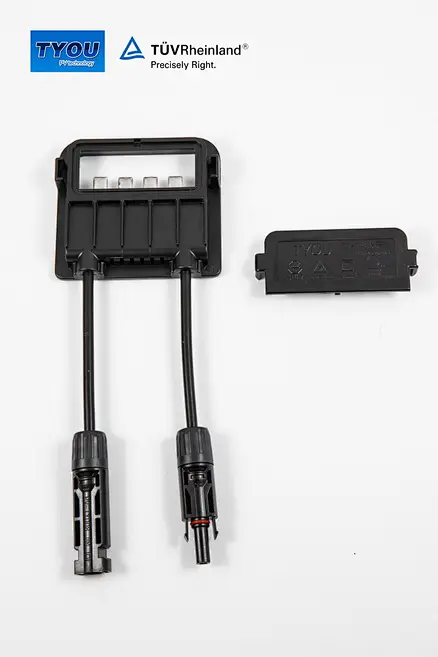
PV-TY806: Integrated Pre-potted PV Panel Junction Box (15A&16A, ≤400W)
Model NO.:PV-TY806

TY002: 3-Part Junction Box for On-site Potting (25A/30A, for 500W~750W Modules)
Model NO.:PV-TY002

- 1